
Line8 Journal
The reason why power tracks need to be expensive & why would you want to pay more for your power track

The reason why power tracks need to be expensive & why would you want to pay more for your power track.
With the surge of popularity of the power track concept, it has caught the attention of numerous Chinese manufacturers. Similar to many other products, these new Chinese brands feel that they are able to produce something similar for cheaper. However, power tracks are not the common fast-moving consumer goods (FMCG). Power tracks are a highly engineered product that pushes the boundary of modern material sciences.
Imagine, a single Line8 Power Track can carry the amount of power as an entire HDB or Condo apartment. Yes, everything in the apartment from the air-conditioning, all appliances, and lights in all kitchen, sitting area, and rooms…plug all that into one single Line8 Power Track and you haven’t overloaded the Line8 Power Track yet.
As much as it sounds impossible, it is made possible by the extensive use of High-performance thermoplastics (HPTPs). The Line8 Adaptor is made from a glass-fiber reinforced polybutylene terephthalate. This gives the Line8 Adaptor characteristics like V0-fire resistance, chemical resistance, high electrical strength, and high rigidity. The Line8 Power Track Conductor Assembly is made from a Super-Engineering Thermoplastic called Xyron (mPPE based) just to name a couple.
High-performance thermoplastics (HPTPs) - What are they and why are they important
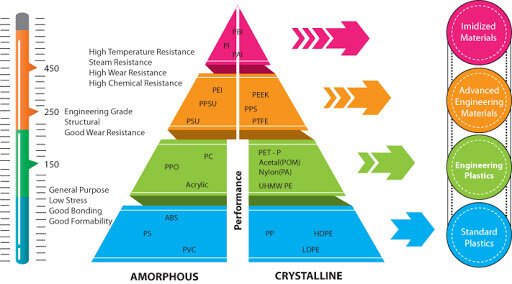
Pyramid of Thermoplastics
High-performance thermoplastics (HPTPs) are thermo-polymers that meet higher requirements than standard or engineering thermoplastics. They are high-priced, low-volume polymers that are sold for use in specialized applications that require a combination of extraordinary properties (the most important being that of high-heat temperature tolerance and performance).
The main applications for HPTPs are electrical/electronics, automotive, aircraft/aerospace, industrial (including oil and energy), and health (medical/dental)
Why are HPTPs important in Power Track Manufacturing
Power Tracks are high-precision, high load power distribution devices. They will need to withstand a much higher electrical load and provide much more electrical power compared to a standard wall socket or any regular electrical appliance.
This kind of design load is typically fulfilled by large and bulky bas-bar systems that distribute power around any building and city.
Having to miniaturize this same technical design into something aesthetically pleasing and sleek requires the use of special materials. Materials than can insulate much better, materials that can withstand much more load, materials that can provide the mechanical and electrical properties
Many have thought, why didn’t power tracks become popular much earlier? The answer to the question is because we didn’t have these HPTPs available for use back then.
Commonly used materials like Polycarbonate (PC), ABS (Acrylonitrile Butadiene Styrene), and Polyvinyl Chloride (PVC) are just not good enough for the demanding electrical and mechanical required to produce a power track.
Not all power tracks are made equal
In conclusion, not all power tracks are made equal. Being made in Singapore and with our access to high-tech manufacturing through our collaboration with A*Star SIMTECH. Topped off with the extensive use of HPTPs. Every Line8 Power Track is proudly made in Singapore with the best in manufacturing technology and material science. A power track is not something that we can replace easily like a poorly made electrical kettle for example. It is something that is permanently installed in your home, therefore it is important to fit one that is known to last.
https://en.wikipedia.org/wiki/High-performance_plastics#cite_note-Elias4-1
https://ihsmarkit.com/products/chemical-high-performance-thermoplastics-scup.html
https://www.a-star.edu.sg/simtech/industry/industry-collaborations
https://services2.hdb.gov.sg/webapp/BN31AWERRCMobile/BN31SElectrical?loadAction=electrical
Line8, a locally founded R&D and Engineering Company develops and manufactures the Line8 Power Track System. Our products have proven to be innovative and aesthetically pleasing in many of our customer's homes locally and overseas.
Learn more at : www.line8.com.sg
Frequently Asked Questions
How much electrical load can a single power track carry?
A single Line8 Power Track can carry as much power as an entire HDB or condo apartment — every air-conditioner, appliance, and light across the kitchen, living area, and bedrooms could be plugged into one track without overloading it. That capacity is only possible because of the high-performance materials used in the track and adaptor construction, not a standard wall-socket build.
What are HPTPs and why do power tracks need them?
High-performance thermoplastics (HPTPs) are high-priced, low-volume polymers built for extraordinary heat tolerance and electrical performance, normally reserved for electronics, aerospace, and medical applications. A power track has to miniaturise the same high-load distribution job a building's bus-bar system does, so it needs materials that insulate and withstand load far beyond what standard Polycarbonate, ABS, or PVC can provide.
Why can't a power track be made as cheaply as a standard wall socket?
A power track is a high-precision, high-load power distribution device permanently installed in your home, not a fast-moving consumer good. It has to withstand far greater electrical load than a regular socket or appliance, which is why it's built from glass-fibre reinforced PBT and Super-Engineering Thermoplastics like Xyron rather than the commodity plastics a standard socket can get away with.
Ready to see it in your own space?
Now choose your track →